A Shared Errand List for a Week on the Move
A shared errand list helps a household group tasks by place, name an owner, and catch changes before a busy week sends everyone in different directions.
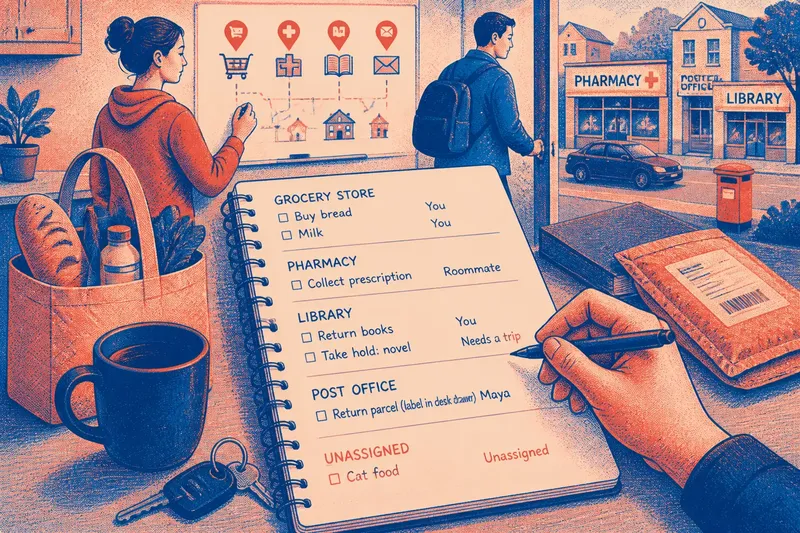
A shared errand list works best when every task has a place and a person attached to it. Without those two details, a household can reach Friday with a bag of library books in the car, a prescription still waiting, and two people who each thought the other had picked up the parcel.
The fix is not a more elaborate planner. Use one shared note, group errands by destination, and give each task a clear owner. Then keep the list flexible enough for a week when plans shift.
Why does the list become a second job?
A list becomes burdensome when it tries to capture every possible detail. A note full of reminders, conversation, and old tasks takes longer to interpret than the errands themselves.
Keep the shared list focused on actions that require someone to leave home or make a specific stop. Put a short task beside its destination: “Return library books — library,” or “Pick up parcel — post office.” If an errand needs a detail, add only the detail that changes what someone must do, such as “bring the return label.”
Put household reminders that do not involve an errand elsewhere. “Use the spinach” belongs on a meal note; “buy spinach at the market” belongs on the errand list.
What causes duplicate stops?
Duplicates often appear when each person keeps a private list, or when the shared note records tasks without showing who plans to handle them. Two people may buy the same item, while a less visible task gets missed.
Choose one place everyone can access, such as a shared phone note, a household app, or a whiteboard photographed and sent to the group. Use it as the current list, not as another copy alongside separate personal versions.
Add an owner to each task. A name or familiar initial is enough: “Maya — pick up parcel.” If nobody has agreed to do it yet, write “unassigned” rather than silently leaving the task open to interpretation.
Say you share a home with a roommate who passes the pharmacy on the way to work, while you usually go to the grocery store. You could assign “roommate — collect prescription” and “you — buy bread at grocery store.” The visible owners make it easier to spot that neither of you has taken the library return.
How should errands be grouped by place?
Group tasks under destinations people actually visit: grocery store, pharmacy, library, post office, or a particular neighborhood. Avoid broad headings such as “outside” or “this week”; they do not help someone decide what to combine.
Under each place, list separate actions on separate lines. “Library: return books” is easier to scan than a long note that also mentions groceries and a parcel. If one stop contains two tasks, such as collecting a hold and returning books, keep both lines beneath “Library.”
Use a shared location only when the errands are genuinely nearby or naturally part of the same visit. A pharmacy inside the grocery store may fit under the grocery stop; a pharmacy across town deserves its own heading.
For a place that no one is certain about visiting, leave the tasks under that destination but mark them “needs a trip.” That makes the open decision visible without assigning someone to a route they have not agreed to take.
Why do assigned errands still get missed?
An owner may be named, but the task can still disappear if the person does not know when it needs doing or what to bring. “Return package” is less useful than “Maya — post office, return package, label in desk drawer.”
Add a timing cue when it changes the plan: “before the library closes,” “on the way home Tuesday,” or “any day this week.” Skip a date when the errand has no real deadline. Too many artificial deadlines make the list harder to trust.
Keep essential details beside the task, not buried in a separate conversation. A parcel’s return label, a library card, or a shopping item’s brand preference may be worth mentioning if forgetting it would force another trip.
Where a task depends on a label, manufacturer instructions, or local rules, check that source before acting; for medical or other professional matters, ask a qualified professional when needed.
What if plans change midweek?
A shared list needs a simple way to show that an assignment has changed. Otherwise, one person may still be planning around a task another person has already handled.
When someone finishes an errand, mark it done or remove it. When they cannot do it, change the owner or mark the task “unassigned.” If the destination is closed, the needed item is unavailable, or the trip is no longer worthwhile, add a brief note explaining the next decision.
Keep completed tasks out of the active list. If you want a record of what was done, move those items to a small “done” section and clear it at the end of the week. A long archive can make current errands harder to find.
How can the list stay fair without tracking every favor?
Sharing errands does not require a scorecard. People have different routes, schedules, and access to a car, so equal numbers of tasks do not necessarily mean an equal load.
Make the practical constraint visible when it affects an assignment: “needs car,” “can go after work,” or “only available Saturday.” Then ask whether the owner can reasonably fit the stop into their week. If not, leave it unassigned and discuss another arrangement rather than treating a name on the list as a promise.
For recurring tasks, rotate ownership only if that feels useful to the household. Some people prefer to keep handling the stop already on their route; others would rather alternate. A quick conversation can settle the preference before the list fills with assumptions.
What should you check before relying on the list?
Where should the shared errand list live?
Put it somewhere every household member can open without searching through old messages. A shared note is simple for a small group; an app may help if people want reminders or separate task owners.
Should every task have a deadline?
No. Add timing only when it affects the route or the task’s usefulness, such as a closing time or a promised pickup window. Otherwise, a flexible cue like “this week” is clearer than an invented due date.
What belongs on the list if no one has volunteered?
Keep the task visible and label it “unassigned.” That tells the household it still needs a decision, instead of making the task look as though someone has quietly taken responsibility.
When should a task be removed?
Remove it once it is complete, or move it to a brief done section if the household wants to see what has been handled. If the errand is no longer needed, mark it canceled so nobody makes the trip by mistake.
How can you start with a list people will use?
At the start of the week, gather the errands people already know about and sort them by destination. Add an owner where someone has agreed, include a useful timing cue, and leave undecided tasks clearly open.
Midweek, make a quick pass for completed, reassigned, or newly needed errands. Keep the shared errand list short enough to scan on a phone while standing by the door; if a task needs a longer discussion, handle that conversation separately and record only the resulting action.
Before anyone leaves, check the destination heading for the small item that could prevent a wasted stop: a library card, return label, shopping bag, or note about what to collect. That final glance keeps a shared plan useful right up to the moment the household heads out.