Before the Search Box: A Short History of Library Catalogues
Library catalogue history explains how readers moved from handwritten lists to searchable records—and how to use today’s catalogues to locate the right item.
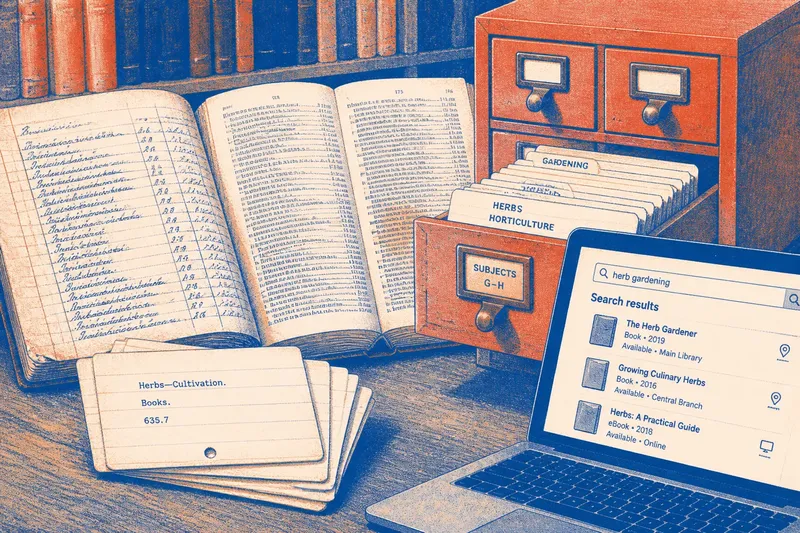
Library catalogue history is a story of changing ways to find a book, not a simple march from paper to computers. A reader with an author’s name, a remembered phrase, or only a subject in mind has always needed a useful route from that clue to an item.
How did early libraries keep track of books?
Some libraries used handwritten lists or inventories to record items in their collections. The format and detail varied with the library’s needs: a list might help staff manage holdings, point to locations, or help readers look up known titles.
These records were not all organized in the same way, and it would be misleading to treat them as one standard system. A list arranged for staff or shelf order, for example, might not help a reader who knew a subject but not a book’s title or author.
As collections and readers’ needs differed, libraries could use more than one kind of record or finding aid. The central challenge was practical: make an item identifiable and provide a route to where it could be found.
A record is useful only if its arrangement matches the question being asked.
Why did libraries produce printed catalogues?
Printed catalogues offered a reference that readers could consult, often with entries arranged by a chosen feature such as author or title. They could make looking up a known name easier, though the arrangement and level of detail depended on the catalogue.
Print also made revisions less immediate than changing a single handwritten entry. A library might issue additions or produce a new edition, but a reader with an older copy could be consulting a version that did not reflect later changes. The pace and method of updating varied between institutions.
Cataloguing conventions mattered, too. Readers needed to know how names, titles, and subjects were represented, while librarians had to make choices about how records were organized. Those choices affected which search routes a particular catalogue supported.
When using an old printed catalogue, check its publication date and any supplements before assuming it covers the current collection.
What made card catalogues useful for changing collections?
Card catalogues let libraries handle individual records separately. Staff could add or revise cards without reprinting every entry, although the exact procedures and catalogue designs differed among libraries.
A catalogue might provide separate entries for the same item under an author, title, or subject. That gave readers more than one possible starting clue. Drawers and dividers helped organize the cards, and a reader could follow the sequence to find an entry and its location information.
The system depended on careful filing. A misplaced card could make a record harder to find, and searching required the reader to select the right drawer and follow its arrangement. Still, separate cards offered a flexible way to maintain records as holdings changed.
Imagine a reader looking for a book about growing herbs but remembering neither its author nor its exact title. If the catalogue has a subject entry for that topic, the reader can follow it to a title and location; if it does not, trying a broader subject term or asking staff may offer another route.
How did library records become searchable on computers?
Computer-based catalogues changed how readers could search stored records. Instead of following one physical sequence of cards, a reader could enter a title, author, or subject and review matching records on a screen.
Computers did not remove the work of describing items. Records still needed details and terms that helped connect a reader’s query to the material. Search tools could retrieve matches quickly, but the results depended in part on what information had been entered and how the system handled the query.
Digital catalogues could also present several kinds of access to an item, such as searches across different record fields. The interface and available features varied, so readers still benefited from checking the item details rather than relying on a result’s title alone.
The screen changed the route through the records; it did not eliminate the need for clear descriptions.
What changed when catalogues moved online?
Online public access catalogues let readers search beyond a library terminal. Depending on the system, a record might show a branch, format, or availability information, and some catalogues let readers request items or explore holdings across locations.
That made “where” a broader question than shelf location. A reader might need to distinguish a branch, a format, or a request option before deciding how to access an item. Features differ by library, so check the specific catalogue’s record and service information.
Online searches can return multiple editions, formats, or related subjects. Filters may help narrow the list, but the item record remains important: compare the author, format, and location details with what you actually need.
Before traveling to a branch, check the record’s current location and availability.
What do readers ask about library catalogue history and searching?
Why can a title search return several records?
Different editions, formats, or translations may have similar titles, and a search can also match words in more than one record field. Compare the author and format details to identify the item you want.
What can I search if I do not know the exact title?
Try a distinctive subject term, an author’s name, or a phrase you remember. If those searches do not help, change the wording or ask library staff which terms or collections might fit.
Why might a catalogue item not be on the shelf?
The record may show that a copy is checked out, located at another branch, or shelved in a different area or format. Check the location and availability fields, then ask staff if those details do not match what you see.
Does one catalogue search every resource a library holds?
Not necessarily; some libraries use separate systems or search pages for books, archives, databases, and other materials. Check for a collection selector or ask a librarian which catalogue covers the resource you need.
How does catalogue history help with a search today?
Each format offered a different way to organize and retrieve records. Handwritten lists, printed catalogues, card drawers, and computer systems did not follow one identical path in every library, but each addressed the practical need to connect a reader’s clue with an item.
When a search stalls, identify the clue you have: title, author, subject, or format. Then check whether the catalogue has a matching search option, and revise the wording or ask staff if the first route leads nowhere.
Library catalogue history also explains why a search result is a starting point rather than the whole answer. Read the item record closely: its format and location can tell you whether you have found the right resource and how to reach it.