The More Options, the Better Myth
A short resource shortlist cuts decision clutter by keeping the useful choices visible and the rest out of the way, without closing off alternatives.
A short resource shortlist is often more useful than keeping every possible option in view. When you need a place to borrow a tool, a repair service, or a source of spare materials, an unwieldy collection can make the simple question—what should I try first?—harder to answer.
The answer is not to delete every alternative. It is to keep the most useful choices easy to find, record why they made the cut, and leave a clear way to look again when your needs change. The right shortlist depends on whether you are choosing under pressure, dealing with an unfamiliar need, or coordinating with other people.
Why can too many options slow a useful decision?
Every visible option asks for a little attention. You may need to recall what it offers, whether it is still available, how far away it is, and what it costs in time or effort. A list that mixes a nearby tool library with an old online listing and a friend who moved away does not offer more useful choice; it offers more checking.
There is another cost: a long list can hide the reasons you trusted any option in the first place. If you saved a repair cafe because it accepts small household items, that detail matters more than its name alone. Without a note, you may have to repeat the search just to remember why it seemed relevant.
Options are valuable when they represent genuinely different ways to meet a need. They become clutter when they are duplicates, outdated, or too poorly described to compare.
Which situation describes your search?
Start with the kind of decision in front of you, not a universal rule about list length. A shortlist for a familiar errand should work differently from one for a rare, uncertain need.
Do you need something familiar soon?
Keep a small, dependable shortlist. If you regularly borrow a drill, for example, a nearby tool library, a neighbor who lends tools, and a hardware store with a rental counter may cover distinct routes. Put the option you are most likely to try first at the top, along with its hours, location, or contact method.
This situation rewards quick recognition more than exhaustive coverage. If the first choice is unavailable, you can move to the next without reopening a broad search.
Is the need unusual or still taking shape?
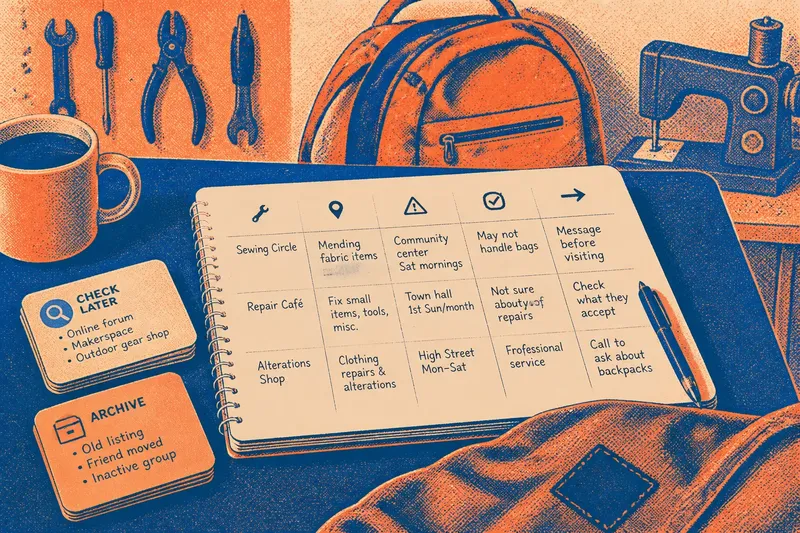
Keep a wider discovery list temporarily, but separate it from the options you already trust. You might be trying to find a source for unusual fabric scraps or a service that repairs a particular appliance. A few promising leads can stay in a “check later” group while you learn what the need actually requires.
Do not treat a discovery list as ready to use. Add a note about what remains unknown, such as whether a group accepts walk-ins or handles the material you have. Once you can compare options on relevant details, promote the best candidates and archive the rest.
Are other people choosing with you?
Keep the shortlist small enough to discuss, but make the reasons visible to everyone. A shared list might include a community workshop, a neighborhood lending group, and a repair service, with a brief note about what each can do. That lets people compare the same information instead of arguing from different assumptions.
Agree on who will check uncertain details and when the list should be updated. A list with no owner can become a shared folder of forgotten leads.
Would missing an alternative cause a serious problem?
Keep a deliberate backup when the consequence of losing access matters, such as needing another place to store essential supplies or obtain a commonly used item. The backup should be a real alternative, not simply another name on the page. Note what would prompt you to use it.
If the need is low-stakes and easy to revisit, a long contingency list is less helpful. Keep the shortlist lean and search again if the first options no longer fit.
What belongs on a useful shortlist?
A name alone is rarely enough to support a decision. Give each option a compact record that helps you recognize when it fits and what to do next.
- What it provides: Name the item, service, place, or kind of help, rather than relying on a vague label.
- Best-fit situation: Note the need it suits, such as borrowing a hand tool or getting advice about a small repair.
- Access route: Record how to reach it, such as a location, contact page, or person who can make an introduction.
- Known limits: Mention a relevant restriction or an unanswered question, so nobody mistakes an assumption for a fact.
- Reason it is here: Add a short explanation, such as “near the bus stop” or “accepts fabric offcuts.”
- Next action: Say whether to call, visit, ask a neighbor, or check availability before relying on it.
Keep notes factual and modest. “May take small repairs; ask first” is more useful than a confident-sounding claim that you cannot verify.
How do you keep the shortlist from going stale?
A shortlist needs occasional maintenance, but it does not need to become a project. Review an entry when you are about to rely on it, or when you learn that a location, contact, service, or routine has changed. If an option is no longer available, remove it or move it to an archive with a clear note.
Use a place you already check: a phone note, a paper card near your household supplies, or a shared document. Avoid scattering copies across messages, bookmarks, and notebooks. Choose one home for the current list, then make that location easy for the people who need it to find.
When you add a new option, ask what it contributes. Does it serve a different situation, offer a useful backup, or replace a weaker entry? If it does none of these, keep it in discovery notes rather than adding it to the active shortlist.
How should you compare and prune options?
Compare choices on the details that matter for this particular need, not on a universal score. For a borrowed ladder, access and transport may matter most; for a repair service, the kind of work it accepts may be decisive. Pick a few criteria before comparing so the list does not grow around whichever detail happens to be easiest to find.
Imagine you need a place to mend a torn backpack. You have saved a sewing circle, a general repair cafe, and a shop that advertises clothing alterations, but you do not know whether any handles bags. Mark that uncertainty on each entry, then contact the options most likely to fit and retain those that can help. The observable result is a shorter list with a clear next move, not a claim that any one choice is automatically best.
Prune entries that duplicate another option without adding a meaningful difference. Keep a second choice when it offers something distinct, such as a different location, schedule, or skill. If two entries appear similar but you do not know enough to choose, note the missing detail instead of pretending the comparison is settled.
What questions help you choose a shortlist?
How many options should a shortlist contain?
Keep enough options to cover the situations you actually expect, including a backup when access matters. There is no useful fixed count; stop adding choices when another entry no longer adds a distinct route or capability.
Should I keep an option I have not used before?
Yes, if it may suit a real need and its unverified details are clearly marked. Keep it separate from options you already know how to use until you have checked those details.
When should I search for more alternatives?
Search again when the current options are unavailable, no longer fit the task, or leave an important need unmet. A shortlist is a starting point for action, not a rule against looking elsewhere.
Is a shared shortlist better than a personal one?
Use a shared list when other people need to choose from the same resources or keep them current. For a private, occasional need, a simple personal note may be easier to maintain.
What is the practical value of a smaller list?
A short resource shortlist makes the next action visible: contact this place, ask this person, or check this detail. It also preserves a route back to discovery when circumstances change. You are not choosing between endless choice and no choice; you are separating useful options from unreviewed possibilities.
Keep the active list grounded in real needs, write down why each entry belongs, and let uncertain leads wait somewhere else. The best shortlist is not the one that claims to contain every answer; it is the one that helps you recognize a sensible next move.