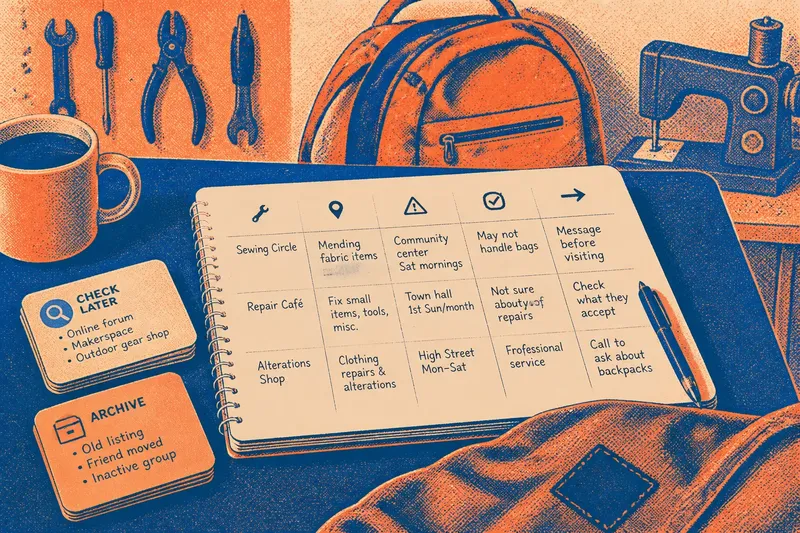
The Two-Minute Brief That Makes a Search More Useful
A two-minute search brief turns a vague resource hunt into a focused task, helping you choose useful results without getting pulled into unrelated options.

A two-minute search brief can keep a resource hunt pointed at the thing you actually need. Before opening a browser, write down the task, the constraints that matter, and the result you must be able to use. That small pause gives you a reference point when search results start offering tempting but irrelevant alternatives.
This is useful for everyday searches: finding a place to donate leftover paint, choosing a free tool for a community event, locating a repair manual, or finding a quiet spot to work. The brief is not a research plan. It is a compact description of what would count as a useful answer for this particular task.
What is the task you need to complete?
Start with a plain-language action. “Find resources for sewing” is broad; “find a local place that can teach me to replace a coat button” names both the activity and the immediate need. A clear task helps distinguish a relevant resource from one that merely shares a keyword.
Write the task as a sentence beginning with a verb: find, borrow, learn, repair, donate, or compare. Avoid trying to solve every future problem at once. If you need a place to borrow a ladder for one shelf, the brief should not expand into a plan for furnishing the whole apartment.
Next, name the person who will use the resource, if that changes what is suitable. “A beginner who has never used a sewing machine” is more useful than “someone,” while details that do not affect the search can stay out. The purpose is to make the search legible to you, not to produce a perfect specification.
Which constraints actually affect your choice?
Constraints are conditions that make an otherwise useful result impractical. They might include location, opening hours, transport, language, accessibility, whether you can borrow rather than buy, or whether the resource must be available today. Note only the conditions that would change your decision.
Separate firm limits from preferences. “Must be reachable by bus” may be firm; “ideally near the grocery store” may be a preference. If both appear as equally strict demands, you can reject a good option for failing a detail that was never essential.
- Place: Does the resource need to be nearby, online, or reachable by a particular route?
- Timing: Is there a deadline, or can you wait for a scheduled session or delivery?
- Access: Do you need step-free entry, a particular language, or a format you can use?
- Cost or exchange: Must it be free, borrowable, or available through a swap?
- Starting point: Does the resource need to work for a beginner or for someone with specific materials?
For a decision that depends on a label, provider instructions, or local rules, check those details directly before acting. A search snippet may be out of date or may leave out a condition that matters.
What result would count as enough?
Define the must-have result as an observable outcome, not a vague feeling. “Find something useful” is hard to evaluate. “Find one beginner-friendly sewing session with a date I can attend” gives you a clear stopping point.
Keep this result distinct from the resource itself. A library page, a community workshop, and a neighbor’s advice are different resources; each might still meet the same need if it gets you to the result. Naming the outcome prevents the search from favoring a familiar type of resource without a reason.
Also decide what information you need before you can choose. For a borrowing option, that might be where to collect the item and whether it is available. For a class, it might be the level, date, and whether materials are provided. You do not need to gather every detail about every candidate; identify the details that could change your choice.
How do you write the two-minute search brief?
Put the three pieces together in a few lines. Keep the wording short enough to reread while searching, and specific enough that you can reject results that do not fit.
- Task: What action am I trying to complete?
- Constraints: Which limits are firm, and which are preferences?
- Must-have result: What observable answer would let me take the next useful action?
Say you want to learn how to repair a coat button before a family gathering. Your invented brief might read: “Find a beginner-friendly way to learn this repair. It needs to be available in person near my neighborhood or through a live online session, and it must fit before the gathering. I need a clear lesson option with its date and any materials I should bring.”
That brief leaves room for different kinds of help while screening out a general sewing course that starts much later or a long article that does not explain the repair. It also gives you a way to judge a result without pretending that the first plausible link is automatically the right one.
How should the brief shape your search terms?
Turn the task into a core phrase, then add a constraint only when it helps distinguish relevant results. For the coat-button example, a starting search could be “beginner button repair class,” followed by a location or “live online” if needed. Searching the whole brief as one long sentence can bury the useful terms.
Use the wording people who offer the resource are likely to use. “Mending workshop,” “clothing repair class,” and “sewing lesson” may lead to different listings for the same general need. Try a close synonym when the first phrase returns material that misses your must-have result.
Search in places suited to the resource. A public library catalog may help with books and repair manuals; a library or community center calendar may list classes; a local mutual-aid group may be a better place to ask about borrowing. These are routes to check, not assumptions that a particular service exists nearby.
Keep the brief visible while you search. If an attractive result does not match the task, a firm constraint, or the must-have result, save it only if it supports a separate need. Otherwise, move on rather than rewriting the original goal to make the result seem relevant.
What should you check before choosing a result?
Compare candidates against the brief, not against one another’s appearance or number of details. A polished page can still omit the information you need, while a plain listing may answer the important questions clearly. Check the source and the specific conditions that affect your decision.
- Does the resource address the task you wrote down?
- Does it meet every firm constraint?
- Can you see how it would lead to the must-have result?
- Is the information current enough for the timing or availability involved?
- Are the details you need for the next action stated, or is there a sensible way to ask?
Imagine you find two invented options for learning the coat repair. One is a broad sewing course with no confirmed dates; the other is a neighborhood mending session that lists its next meeting and says beginners are welcome. If the brief requires a session before the gathering, the second option is the clearer fit, provided its remaining details work for you.
If a promising listing is incomplete, ask one focused question rather than starting the search over. “Are beginners welcome, and should I bring a needle and thread?” is more actionable than “Can you tell me more?” A reply can fill a gap, but it should not persuade you to overlook a firm constraint.
How can you keep the search brief without making it rigid?
Treat the brief as a working note, not a contract. If the search reveals that your preferred route is unavailable, you can revise a preference or consider another kind of resource. Keep the original task and must-have result steady unless you have a real reason to change them.
For example, you might first hope to attend a local class, then discover that no suitable session fits your schedule. If learning the repair is the true result, a live online lesson could be an acceptable alternative. If you specifically need hands-on help, that change would not meet the original need, so the next search should focus on a different local contact or time.
After you act, note whether the resource did what you needed. A short comment such as “explained the repair, but did not cover thick fabric” can improve a later search without turning the two-minute brief into a diary. The note is most useful when it changes a future constraint or makes the must-have result clearer.
What do people often ask about a two-minute search brief?
How long should the brief be?
Keep it to a few lines: one sentence for the task, a short list of meaningful constraints, and one sentence for the must-have result. If it takes longer to write than the search itself, remove details that would not change your choice.
Should I write the brief before or after choosing search terms?
Write it before choosing terms so the wording of search results does not quietly redefine the task. Then use the task and constraints to create a short core phrase and add useful qualifiers as needed.
What if I do not know what result is realistic?
Describe the smallest result that would let you take a useful next action, such as finding a contact, a relevant catalog record, or a session to ask about. If the search shows that the result is not available in your preferred form, revise a preference while keeping the underlying task clear.
Can one brief cover several related needs?
Usually it is clearer to write a separate brief when the needs have different constraints or stopping points. If two needs share the same task and conditions, keep them together only when one resource can reasonably serve both.
A two-minute search brief makes a resource hunt more useful by giving you a concrete standard for relevance before the results begin to compete for attention. For your next search, write the task, the constraints that truly matter, and the outcome you need; then choose the first result that meets those conditions and gives you a sensible next action.